

THE FUTURE OF FREIGHT PROTECTION BELONGS TO THE COMPANIES THAT STAY OPEN
The strongest monitoring strategy is not built around one manufacturer, one sensor, or one way of thinking. It is built to evolve, because freight risk does not stay still for very long.
A few years ago, many operations were focused mainly on location visibility. If a shipment was moving, arrived on time, and stayed on route, that covered most of what people wanted to know. Today, that is rarely enough.
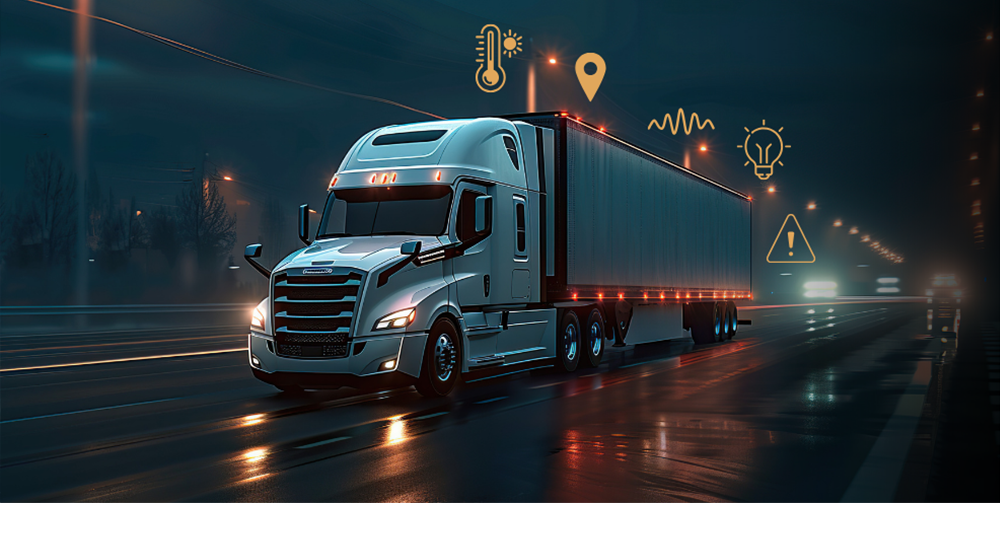
A pharmaceutical load may need temperature alerts the moment a trailer starts drifting outside tolerance. A rack of sensitive electronics may need vibration monitoring because a rough handoff can create damage long before delivery. A sealed trailer may need light detection because a brief opening in the wrong place tells a completely different story than a delayed stop. These are no longer unusual requests. They are becoming standard expectations.
What is changing now is that the conversation is moving beyond traditional monitoring devices.
More operators are asking what else can live inside the same environment: a camera connected directly into a live shipment view with two-way communication, a loud alarm that can be triggered remotely when intervention is needed, a true door-open device that confirms physical access instead of inferred movement, even fog or other deterrents designed to create hesitation during an attempted intrusion.
As Nick Erdmann, Director of Business Development at Vectura puts it, “The next good security idea should never fail because the platform has nowhere to put it.”
That is exactly where many monitoring environments quietly hit their limit. They work well as long as the shipment fits the device family they were originally built around. But once a different type of sensor, response tool, or hardware idea enters the conversation, limitations appear quickly. If the platform only accepts one manufacturer, every future decision is shaped by what that manufacturer offers.
That becomes a real problem because freight changes constantly. The risks around pharmaceuticals are different from electronics. Food moves differently than data center equipment. What protects one load may not be the right answer for the next.
A monitoring strategy should not force every shipment into the same technical box. It should allow the right device, the right sensor, or the right response tool to fit the actual exposure.
That is why open platforms matter more now than ever, not because every shipment needs every feature, but because no one can predict which tool becomes essential next year, next quarter, or even next month.
At Vectura, that thinking shaped how we built our platform. We chose to stay device agnostic so customers are not locked into one manufacturer, one sensor type, or one fixed path forward.
Temperature devices, vibration sensors, light detection, location alerts, and future additions all need a place to be monitored, managed, and turned into action inside one environment.
Because the real advantage is not just seeing more data. It is having a platform ready for whatever better protection looks like next.
If you want to see how everything can live inside one platform without being locked into one device path, reach out. We are happy to show you how Vectura approaches it.